
Table of Contents
Best Affiliate Software for SaaS Companies

The best SaaS affiliate software can explain why each commission exists and what happens when a customer changes their subscription. Start with your billing provider and the rules you promise affiliates. Then check whether the system can apply those rules to renewals, plan changes and refunds before anyone gets paid.
Affiliate software works for a program that compensates external promoters for qualifying sales. For incentives that existing customers share with other customers, see our SaaS referral program guide. If the team needs partner onboarding, shared deal registration and an operating portal, that is a broader purchase.
Compare one subscription from click to payout
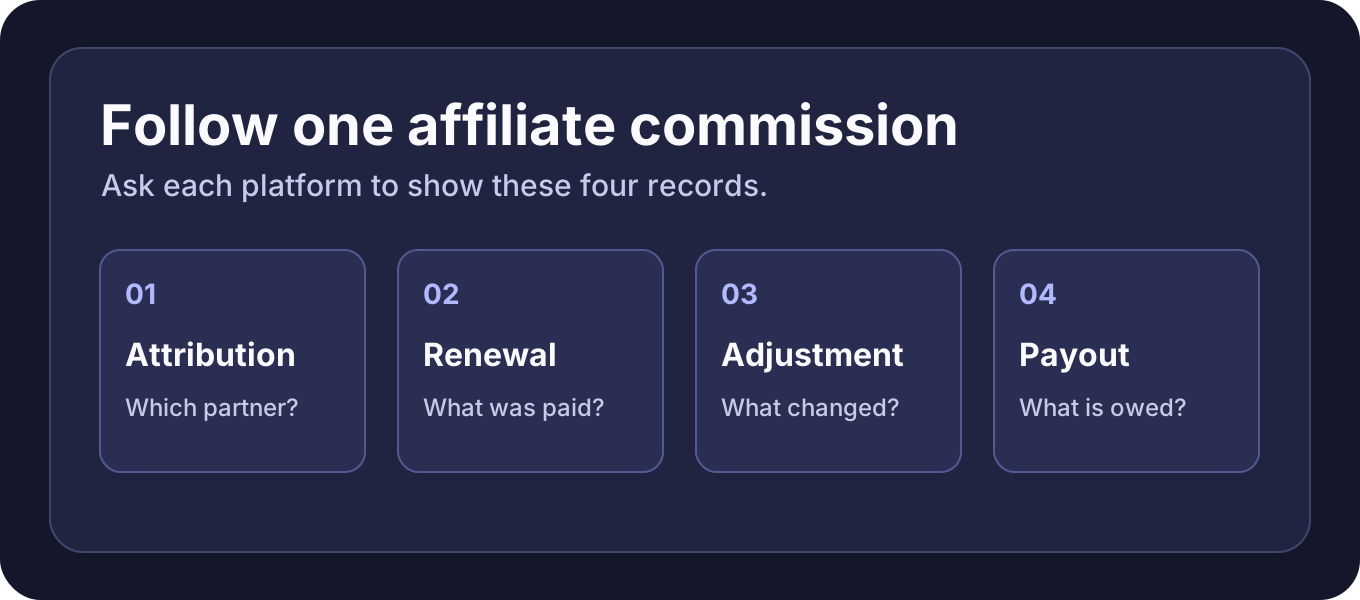
Use the same hypothetical subscriber when you evaluate each vendor. Have the subscriber sign up through a partner, make an initial payment, renew once, then request a partial refund. Ask to see the attribution and commission record after each event. The original payment, refunded amount, commission adjustment and payout status should be traceable. These are proposed buyer checks based on official documentation.
The prices and terms are public vendor references in US dollars. The table scrolls horizontally on smaller screens.
| Product | When to evaluate it | Public price reference |
|---|---|---|
| Rewardful | Stripe or Paddle Classic with a straightforward starting program | Starter $49 monthly for up to $7,500 in monthly affiliate-attributed revenue |
| FirstPromoter | Recurring commission rules across several billing providers | Starter $49 monthly for up to $5,000 in monthly affiliate revenue |
| Reditus | SaaS affiliate tracking with the option to pay for marketplace discovery | Growth $1,188 annually; marketplace listing starts at $4,788 annually on Scale Up |
| Tolt | Stripe, Paddle or Chargebee with a choice of manual or managed payouts | Growth $99 monthly for up to $20,000 in monthly partner revenue; managed payouts cost extra |
Compare tracking, discovery and payouts separately
Rewardful for a Stripe or Paddle Classic subscription program
Rewardful pricing lists Starter at $49 per month or $490 per year, with a monthly affiliate-attributed revenue cap of $7,500. Starter supports one campaign and up to two team members. Rewardful’s Paddle integration guide specifies Paddle Classic. If you use the newer Paddle Billing, compare the documented connectors from FirstPromoter and Tolt. The Stripe integration guide describes recalculating commissions after full or partial refunds. Review your exact subscription checkout and the timing of the reversal before paying affiliates.
The 0% transaction fee on affiliate-attributed revenue is a different line item from optional managed payouts. Rewardful documents a 3% processing fee on each managed payout and an ACH-capable funding method. Rewardful sends an invoice covering commissions and processing fees, which you pay using the linked funding method. Check eligibility and available withdrawal methods for your affiliates. For example, $1,000 in commissions funded through this option would incur a $30 processing fee before the subscription or any affiliate withdrawal fees.
FirstPromoter for a wider set of subscription integrations
FirstPromoter pricing lists Starter at $49 monthly or $490 annually, with up to $5,000 in monthly revenue from affiliates. Business costs $99 monthly and raises the listed cap to $15,000 per month. Its integration documentation covers Stripe, Paddle, Chargebee, Recurly and Braintree. Check the exact connector and checkout implementation before assuming coupon tracking or event support carries across providers.
The recurring commission documentation describes percentage and fixed rewards, including recurring and time-limited options. The payout guide describes negative commissions after refunds and configurable payout delays. Choose a delay that covers your refund policy and check whether a reversal after payment is recovered from later commissions.
Reditus for SaaS teams evaluating a marketplace listing
Reditus pricing shows Growth at $99 per month equivalent with $1,188 billed annually and Scale Up at $399 per month equivalent with $4,788 billed annually. Growth includes the affiliate toolkit and automated payouts. The public plan matrix places marketplace listings on annual Scale Up and Enterprise plans and quotes payout fees of 5% by card or 2% by invoice. The annual Growth price reference applies to up to $60,000 in combined annual recurring revenue as defined by Reditus. Ask what the cap includes for a program running both referrals and affiliates.
Tetriz previously helped Reditus with a Product Hunt launch, as described in our lead generation guide. That work is separate from the documentation used for this software comparison.
Tolt for teams comparing manual and managed payouts
Tolt pricing lists Growth at $99 monthly for up to $20,000 in monthly partner revenue and lists Stripe, Paddle and Chargebee integrations. Tolt’s payout documentation describes manual payouts on every plan. With manual payouts you export the amount owed, pay the partners and record the payout in Tolt. Tolt’s automatic payout documentation puts that service on Growth and higher plans and lists a 2% processing fee. For a $1,000 commission batch, the 2% fee alone adds $20. Tolt’s invoice funding guide lists a separate $8 charge for ACH or US bank transfer, or 4% per invoice by card. If you fund that example with ACH, the documented fees add $28 before the subscription. Check who collects the partner’s payment and tax information and what happens when that information is missing.
Check who earns the commission
Give two partners different tracking links and ask the vendor to show who gets credit when a buyer clicks both before subscribing. Then repeat the example with a partner-specific coupon from someone other than the last referrer. Expected results should follow your program’s written rules for both the first payment and later renewals.
Rewardful’s campaign settings document first- or last-touch credit for competing links and a configurable referral window. FirstPromoter’s campaign settings describe last-click as the default and a first-click setting. Tolt’s attribution documentation describes reassignment of an unpaid lead under last-click, while its coupon settings document assigning credit through a unique code. Ask the vendor to show what wins when the link and coupon disagree in your checkout.
Test refund and payout rules before choosing a plan
Two tools can both advertise recurring commissions and still handle the same refund differently. FirstPromoter’s recurring commissions guide describes recording a negative commission after a refund. Rewardful’s Paddle Classic documentation describes recalculating the sale and commission after a partial refund. For a concrete example, take a $100 renewal, a 20% commission and a $25 partial refund. A proportional adjustment would reduce the commission from $20 to $15. Rejecting the full commission would leave $0 on that renewal. These are two possible accounting results for the example.
The current Reditus commission guide describes rejecting the full commission after a full or partial refund, whether the refund arrives from Stripe or through the Payments API. Confirm how your finance team handles a rejected commission if it has already been paid. Tolt documents refunded and paid statuses and configurable approval timing. Ask separately what happens to a partial refund on your connector and to a commission you have already paid.
Before approving a payout, compare the billing event date with the platform’s commission due date. Rewardful’s commission status guide describes a default 30-day pending period from the sale, which can be changed to match the refund policy. FirstPromoter’s payout guide describes NET-30 as 30 days after the end of the commission month. For a commission earned early in the month, those rules can yield different cash dates. Check how your refund window, minimum payout and payout provider interact before setting the schedule.
Record the plan fee, commission due, payout fee and any ongoing integration work separately. Then compare at one expected level of affiliate-attributed revenue. Use the provider’s definition of that revenue and confirm whether the next tier is triggered by a single month or a sustained change.
Check which referrals require a review
Agree on a rule for self-referrals before testing detection. A reseller signing up a customer might be permitted to use its own link, while a subscriber claiming a commission on their own purchase might be excluded. Test both cases and check what the vendor records, who can override a decision and whether finance can see the reason.
Rewardful describes flagging potential self-referrals for review. Tolt lists Radar rules for blocking self-referrals on Pro and Enterprise. Tolt’s Growth plan can handle managed payouts, while Radar requires a different tier. Check the plan for both capabilities if you need them together.
Rewardful and FirstPromoter document CSV exports for bulk payouts. Ask for the separate transaction or commission export as well. Use one approved commission, one rejection and one adjustment to see whether your finance team can reconcile the related payment IDs. Confirm that the totals reconcile to a single payout and that the partner sees the statuses they need to understand the payment.
Shortlist by the problem you need to solve
Start with Rewardful when one Stripe or Paddle Classic campaign and a clear plan limit fit your operating model. Consider FirstPromoter when billing compatibility and how long each partner earns a commission drive the decision. Consider Reditus when your program needs both tracking and a plan that includes marketplace exposure. Evaluate Tolt when you want to compare manual payments with a managed payout service on the same plan.
At an illustrative $6,000 in monthly attributable revenue, Rewardful Starter stays below its published $7,500 cap, while FirstPromoter Starter exceeds its published $5,000 cap. Use that comparison only after confirming that each provider counts the same revenue in your program. Keep payout fees, commissions and the subscription on separate lines so the next plan comparison uses the same inputs.
How we compared these tools
We used public vendor pricing and support documentation to compare plans, billing integrations, refund handling and payouts. The payment examples use hypothetical figures. Ask the vendor to demonstrate a renewal and a refund from your own billing configuration before moving your program.