
Table of Contents
Best Employee Advocacy Platforms for B2B Teams

Employee advocacy platforms help a B2B marketing team give employees useful content to share through their own professional networks. The buying decision includes the employee’s experience, the editor’s approval workflow and the evidence you can bring back to the business.
Compare DSMN8 and EveryoneSocial when you want a dedicated advocacy platform. Evaluate Sprout Social Employee Advocacy or Parliament by Hootsuite when the team already works in those social suites. Include Oktopost when the purchase also covers B2B social management and connections to marketing and CRM systems.
Begin with the people who want to participate and the topics they can contribute to. Our LinkedIn content strategy guide covers choosing useful topics. Our LinkedIn scheduling comparison covers publishing calendars for profiles and company pages.
Compare the program each platform needs to support
Ask every vendor to price the same starting roster, editor count, regions and reporting requirements. Then confirm how that configuration changes as participation grows.
| Platform | Program to evaluate | Purchase reference to verify |
|---|---|---|
| DSMN8 | Dedicated employee and executive advocacy with selected modules | Custom quote by employees, modules and add-ons; annual contracts |
| EveryoneSocial | A larger advocacy rollout with user provisioning and implementation | One quoted plan priced by users |
| Sprout Social Employee Advocacy | Content curation and reporting alongside an existing Sprout workflow | Advocacy add-on available with Standard and higher plans |
| Parliament by Hootsuite | Approved content sharing and participation reporting within Hootsuite | Request Parliament pricing; confirm any required Hootsuite subscription |
| Oktopost | Advocacy alongside B2B social operations and CRM-connected measurement | Quote advocacy access together with the required platform package |
DSMN8 for a dedicated advocacy rollout
DSMN8 pricing describes custom quotes based on employee seats, modules and add-ons, with annual contracts. Its pricing page lists unlimited administrator seats and onboarding, and asks buyers to specify modules such as Advocacy and Executive Influence. Confirm the configuration for your actual employee roster and support requirements. An annual contract needs a participation plan as well as an initial invitation list. Ask how reassignment works when an employee leaves and how added modules affect the renewal.
Have an editor prepare one product announcement and a subject matter expert prepare an educational post. Ask how each reaches the intended employee group and what the employee can personalize before sharing. Check the exact workflow in the quoted modules.
EveryoneSocial for user provisioning and program operations
EveryoneSocial’s current pricing page presents one plan priced by users. It lists integrations, implementation and user provisioning controls such as single sign-on (SSO) and automated account provisioning through SCIM. Ask which users count toward the contract and how the vendor handles departures and inactive participants.
During the demo, remove access for one test employee and check what happens to their saved content and connected profile. Ask the administrator to distinguish registered users, active users and people who shared a post in the reporting period. Use those definitions when estimating the workload and cost of the program. A user-based quote needs the same roster definition as your budget. Confirm whether an invitation, registration or active participant creates a billable user.
Sprout Social Employee Advocacy for teams already using Sprout
Sprout’s pricing page presents Employee Advocacy as an add-on available on Standard and higher plans. It describes content curation, UTM campaign-tracking parameters, tagged reporting and story discovery through feeds and notifications. Ask for the cost of the base subscription and the advocacy roster together.
Sprout’s account connection guide describes sending content from the social calendar into advocacy and creating advocacy stories while preparing Sprout posts. That can fit a team with an existing corporate publishing process. Verify the permissions an editor needs in each product and who can approve an employee-facing story. The connection guide says the added functionality applies across all account groups. Demonstrate the intended access for each participating team when evaluating a shared program. The advocacy add-on is a separate purchase decision even when the team already pays for social publishing. Check that your quoted base plan includes the connection you intend to use.
Parliament by Hootsuite for an existing Hootsuite program
Hootsuite’s employee advocacy page calls the product Parliament and explains that Amplify evolved into it. Use the current product name when requesting the quote and checking documentation.
The page describes administrators preparing approved content, employees sharing it to their own social channels and administrators tracking post performance and adoption. Ask the vendor to show an employee’s sharing view alongside the administrator’s report. Include the subscription, participant allowance and reporting access in the quote.
Oktopost for advocacy within B2B social operations
Oktopost’s advocacy cost guide describes employee advocacy within its B2B social management platform and connections to marketing automation and CRM systems. Ask which records and interactions reach the systems your revenue team uses. The official Advocacy Board page describes content segmentation, employee suggestions and stakeholder approval before content reaches the board. Ask the demo team to follow one suggested story through approval and show which employees receive it.
Its current demo page offers a pricing and rollout discussion. Request a written quote for the advocacy users, administrator seats, integrations and implementation work your program needs. Use a tagged content link in the demo and inspect the destination session and associated CRM record before treating a reported pipeline amount as attributable to advocacy.
Compare the same annual program cost
Give each vendor one written brief with the employee roster, expected active participants, editors, regions and required integrations. Ask for the annual subscription, any base social platform, implementation and optional modules as separate line items. Confirm what changes the bill: an invitation, a registered employee, an active user, an administrator or an added module.
Budget the internal work too: someone must collect useful stories, check permissions, refresh outdated posts and answer employee questions. After a pilot, divide the complete program cost by the number of participating employees using the same activity definition and reporting period. A cheaper seat can still create a more expensive program if few people keep using it. This is a budgeting framework, not a quoted price or a claim that any vendor guarantees participation.
Follow one story from approval to an employee share
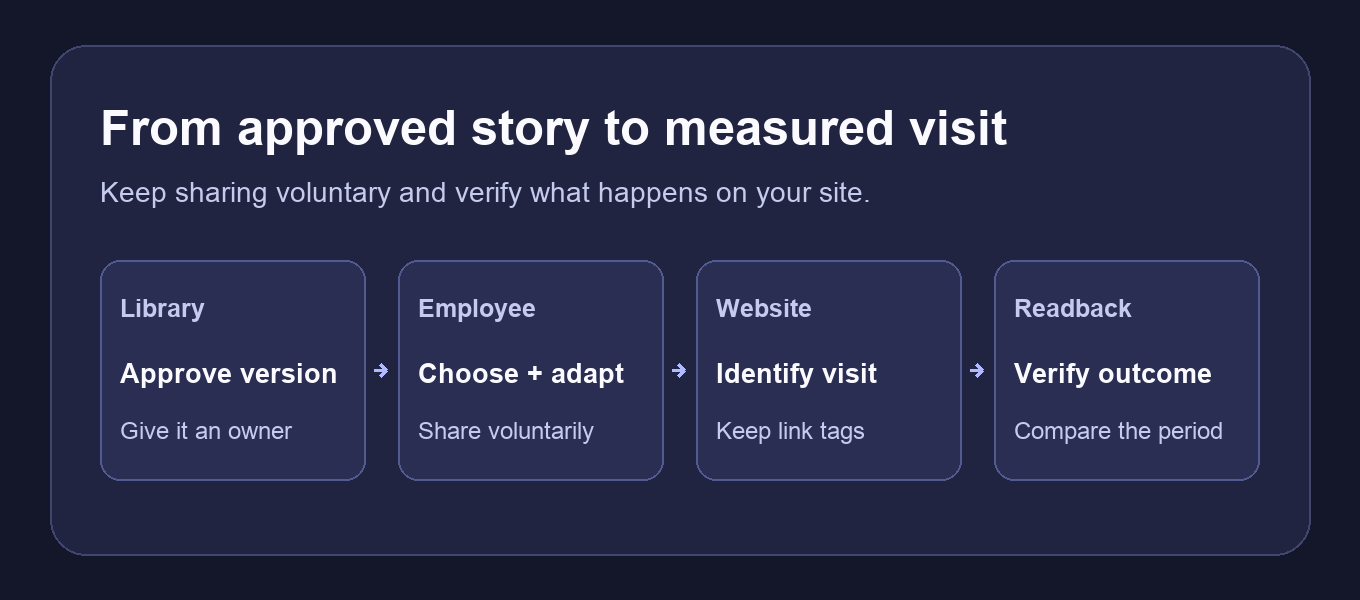
Give each vendor the same draft story and link. Assign it to one employee group, revise it after approval and then remove it from the library. Ask the employee to show which version they can see, edit and share at each step.
The employee should understand the suggested post and choose whether it fits their audience. Ask how personal wording is reviewed and how the program handles a participant who wants to stop. These are proposed buyer checks to run in the vendor configuration.
Check how the system handles language variants, expired campaigns and access for employees who move teams. An editor should be able to see which content remains available and which version received approval.
Measure participation and landing-page activity
Agree on the definitions before comparing dashboards. Invited employees, registered users, active users and employees who share are different counts. Track them over the same period and inspect how each vendor defines activity.
For content performance, keep the post, campaign and destination link identifiable. Compare the clicks reported by the platform with visits and useful actions recorded on the destination website. Ask which tracked parameters survive the employee’s final sharing workflow and what the report does when a link is copied outside the app. Keep estimated media value separate from recorded visits, opportunities and revenue. A paid-media-equivalent estimate uses assumptions about what reach or clicks would have cost to buy. It does not establish that advocacy produced that amount of sales.
A useful pilot starts with a willing group and a steady supply of relevant stories. Compare sustained participation, editing effort, landing visits and any verified downstream actions with the process you already use. Use the observed pilot results to decide whether the larger contract fits your team.
Choose a platform for the program you can run
Shortlist DSMN8 or EveryoneSocial when a dedicated program owner needs to manage employee participation across the business. Shortlist Sprout or Parliament when your corporate publishing team already uses the corresponding suite and can demonstrate the employee workflow in the quoted configuration. Evaluate Oktopost when corporate social publishing, advocacy and CRM-connected reporting form one purchase decision.
For each shortlist, compare the full annual configuration with the people, stories and reporting work your team can maintain. Use the pilot’s observed employee participation and website activity to decide whether the proposed roster and contract fit.
How we compared the platforms
This comparison uses current vendor product, pricing and support information. It is based on documentation research rather than a hands-on platform test. The story and reporting examples are proposed evaluations. Confirm package access, contract terms and the actual employee workflow before purchase.
Product and pricing references checked on November 26, 2026.