
Table of Contents
Best AI SEO Tools in 2026: Pricing and Engines Compared

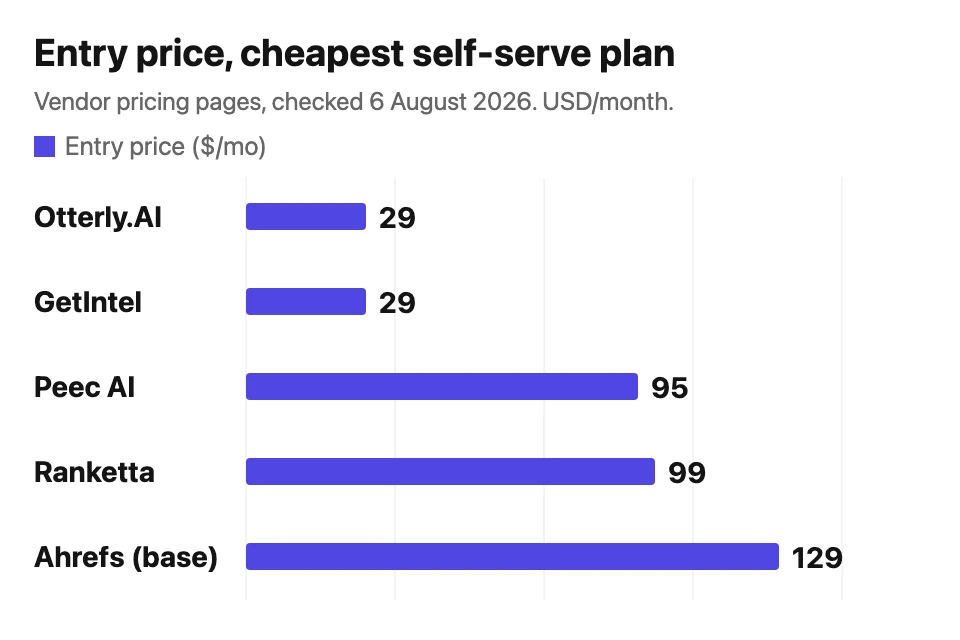
Entry prices for AI SEO tools run from $29 to $129 a month, and the number of AI engines you get for that money runs from zero to four. Those two facts do not move together, which is why comparing these tools on price alone gets people to the wrong answer. Every figure below was checked against the vendor’s own pricing page on 6 August 2026.
That last point matters more than it should. Most roundups in this category carry pricing that is months out of date — several still quote Otterly at $89 when its entry plan is $29.
What “AI SEO tool” actually means now
Two different products go by this name, and buying the wrong one is the most common mistake in the category.
AI-assisted content tools help you write and optimise pages faster — Surfer, Frase, Jasper and similar. They have been around for years and they optimise for Google’s blue links.
AI visibility tools measure something else entirely: whether ChatGPT, Perplexity, Gemini and Google AI Overviews name and cite your brand when a buyer asks them for a recommendation. That is a different unit of success — not a ranking position, but whether you appear in a composed answer at all.
This roundup covers the second kind, because that is the part of the stack most teams have not bought yet.
The tools
GetIntel — $29/mo
Four engines on every paid plan (ChatGPT, Perplexity, Gemini, Google AI Overviews), with Claude added on the $99 Growth tier. Starter tracks 30 buyer questions, Pro 60 at $49, Growth 120.
Its distinguishing feature is what happens after a gap is found: it drafts the artifact meant to close it — llms.txt entries, Schema.org and Wikidata markup, counter-article briefs, outreach emails — and ships it through a coding agent like Claude Code or Cursor as a reviewable diff, or to WordPress, Ghost or Webflow. Nothing publishes without approval.
Best for lean teams where the same one or two people have to both spot the problem and fix it. Less useful if you already employ writers and developers with the capacity to act on a report, in which case you are paying for drafting you would not use.
Otterly.AI — $29/mo
Four core engines on every tier (ChatGPT, Google AI Overviews, Perplexity, Microsoft Copilot), with Claude, Gemini and Google AI Mode as paid add-ons — priced by tier, from $9/month for Gemini or AI Mode on Lite up to $439/month for Claude on Premium. Lite covers 15 tracked prompts, Standard 100 at $189, Premium 400 at $489.
Daily tracking on all tiers, plus brand sentiment analysis and coverage across 50+ countries — genuinely useful if you sell into several markets, and something most tools in this list do not offer at all. Standard and Premium add API and MCP access.
Best for multi-market teams, and anyone who needs sentiment rather than just presence. Watch for the jump from 15 prompts to the next tier at $189.
Peec AI — $95/mo
Three engines, chosen from a pool of six (ChatGPT, Google AI Mode, Google AI Overviews, Microsoft Copilot, Perplexity, Gemini). Starter covers 50 prompts, Pro 150 at $245, Advanced 350 at $495. Annual billing takes 15% off and all paid plans include unlimited seats.
Extra engines are an add-on that scales with your plan — roughly €30/month on Starter, €70 on Pro, €140 on Advanced. Claude sits outside the self-serve pool entirely, on Enterprise.
Best for European teams — its GDPR positioning is a genuine procurement advantage — and for anyone who wants unlimited seats without an enterprise conversation.
Ranketta — $99/mo
Ranketta’s Starter plan tracks three engines — ChatGPT, Google AI Overviews and Perplexity — with 25 prompts, two generated articles a month, one website and 100,000 visitor-analytics events. It costs $99 month to month or $82/month billed annually. Pro is $275/month for 100 prompts, six generated articles, two websites, Ranketta AI, MCP access and a Looker Studio integration, but it still tracks the same three engines. Gemini, Claude, Google AI Mode and Microsoft Copilot require Enterprise.
The measurement method is the interesting part. Ranketta queries the public web interfaces repeatedly from a logged-out perspective rather than treating one API response as ground truth, then reports visibility as a percentage. It supports country-specific prompts across 70 countries. The product is built around e-commerce and DTC workflows, with product-level monitoring and catalogue enrichment, although AI shopping and sentiment are Enterprise features and product-data enrichment is priced separately from Starter and Pro.
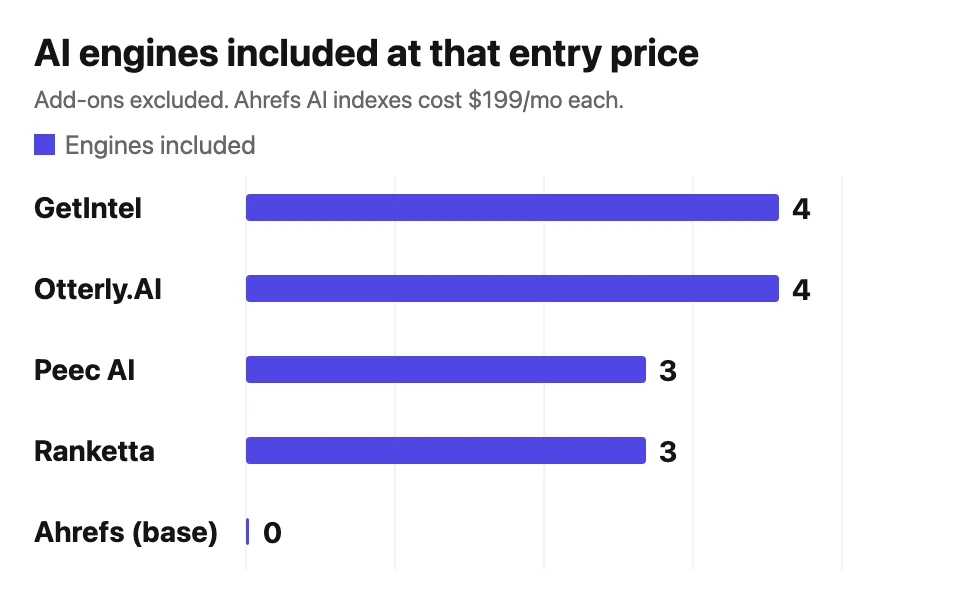
Best for e-commerce teams that care about product visibility, country-level tracking and feed execution. Less useful if you only want broad engine coverage: at the $99 entry price it covers three engines and 25 prompts, versus four engines and 30 prompts from GetIntel at $29.
Ahrefs Brand Radar — $129/mo base, plus $199 per engine
Not a dedicated AI visibility tool but an AI layer on a full SEO suite, and its prompt corpus is far larger than anything a startup in this space has assembled — Ahrefs cites figures in the hundreds of millions of search-backed prompts.
The pricing structure is the thing to understand. A Lite plan is $129/month, then each AI platform index is $199/month on top, or $699/month for all of them. Full AI coverage on the cheapest qualifying plan lands near $828/month — though that also buys you backlink analysis, keyword research, rank tracking and site auditing, which none of the others attempt.
Best for teams already inside Ahrefs who want AI visibility as one more report. Watch for the per-index maths if AI visibility is the only reason you are buying.
How to choose
Count engines per dollar, not dollars. The chart above is the whole argument. At $29 you can get four engines, while Ranketta includes three at $99. Price alone tells you almost nothing.
Check which engines your buyers actually use before you buy any of them. This is free and most people skip it. Take your ten most important buyer questions and put them into ChatGPT, Perplexity, Gemini and Google AI Overviews by hand. If your market lives in Microsoft’s stack, Copilot coverage matters and half this list drops out. If it does not, paying for Grok coverage is money set on fire.
Do not trust a blended score. Engines cite very different sources from one another. In GetIntel’s own 100-question study of Google’s three AI surfaces, run on 5 August 2026, 1,011 of 1,364 cited domains appeared on only one surface — and AI Mode cited 16.38 unique domains per answer against Gemini’s 3.43, a 4.8x spread inside a single company’s products. The per-answer raw data is published as CSV alongside it, so those numbers can be recomputed rather than taken on trust. A tool that averages engines into one number hides exactly the detail you need.
Ask what happens after the gap is found. Every tool here will tell you a competitor is cited instead of you. They differ enormously in whether anything follows from that. If your bottleneck is knowing, buy the cheapest thing that measures well. If your bottleneck is shipping, that is a different purchase.
Prompt volume matters more than the feature list
The number nobody compares is how many buyer questions you can track, and it decides how much of your category you can actually watch.
| tool | entry price | prompts included |
|---|---|---|
| GetIntel | $29 | 30 |
| Otterly.AI | $29 | 15 |
| Peec AI | $95 | 50 |
| Ranketta | $99 | 25 |
Fifteen prompts covers one product’s core buying moments. It does not cover a category. If you are evaluating on a trial, run out the prompt limit before deciding — it binds sooner than any feature does.
The honest caveats
llms.txt is not the lever it is sold as. Several tools in this category market llms.txt generation prominently. SE Ranking studied roughly 300,000 domains and found no measurable effect on AI citations — reported by Search Engine Journal, which notes the file was present on only about 10% of domains crawled — and Google has said it does not use the file. Publish one if you like — it is free and harmless — but be sceptical of anyone selling it as the fix.
These prices move. Otterly’s entry tier has changed. Ranketta’s own older comparison pages still show previous euro prices while its live pricing page has moved on. Check the vendor’s current pricing page before deciding, not a roundup — including this one.
Nobody in this category has run a controlled head-to-head. Any comparison presenting one tool beating another on a measured test should be treated with suspicion unless the methodology and raw data are published. Most are reconstructions from marketing pages, this article included.
How this comparison was put together
Every price, prompt limit and engine list above was read from the vendor’s own pricing page on 6 August 2026 — not from other roundups, which is where most of the stale figures in this category come from. Where a number could only be found in third-party coverage, it is not in this article.
What this is not: a hands-on test. No one ran all five products side by side against an identical prompt set and measured which surfaced more accurate citations. That study would be worth doing and, as far as we can find, nobody has published one. Treat every “best for” line above as a reading of published capabilities and pricing, not a benchmark result.
Two figures come from published research rather than a vendor page: the 100-question Google-surfaces study was run by GetIntel, which publishes its raw per-answer data as CSV, and the llms.txt finding is SE Ranking’s. Both are linked above so they can be checked at source.
Frequently asked questions
What is the best AI SEO tool in 2026? There is no single best one, and the honest answer depends on which AI engines your buyers use and whether your bottleneck is measurement or execution. For most small teams the practical shortlist is GetIntel or Otterly.AI at $29, both covering four engines. Ranketta is the specialist option for e-commerce teams that need country-level, product and catalogue workflows. For teams already paying for an SEO suite, Ahrefs Brand Radar avoids a second vendor.
How much do AI SEO tools cost? Entry tiers run $29 to $129 a month as of August 2026. GetIntel and Otterly.AI start at $29, Peec AI at $95, Ranketta at $99, and Ahrefs at $129 before per-engine add-ons of $199 each. Prices read from each vendor’s own pricing page on 6 August 2026 and current as of that date.
Which AI engines should I track? The ones your buyers actually use, checked separately rather than blended. ChatGPT, Perplexity, Gemini and Google AI Overviews cover most B2B buying behaviour. Microsoft Copilot matters if your market runs on Microsoft’s stack.
Is AI SEO different from traditional SEO? Yes, in what you measure. Traditional SEO competes for a position in a list of links; AI search competes to be the source an engine reaches for when composing an answer. The technical groundwork overlaps — crawlable, well-structured content helps both — but a page can rank first and never be cited.
Do I need an AI SEO tool if I already use Ahrefs or Semrush? Only if AI visibility is a job you actually have. Both suites now offer AI-visibility modules, and Ahrefs’ costs $199 per engine on top of the base plan. If you only need one or two engines tracked, the add-on may be cheaper than a second subscription. If you need four or more, a dedicated tool usually is not.